BEFORE YOU SAY “I DO”- UNDERSTANDING VALID, VOID, AND VOIDABLE MARRIAGES IN SOUTH AFRICAN LAW
 Moletelaw
Marriage isn’t just a ceremony or a celebration or a commitment, is a legal status with far‑reaching consequences for property rights, succession, spousal maintenance, and personal dignity. Yet many spouses only discover, sometimes years later, that their marriage was never legally valid, or that it suffered from vulnerabilities they were unaware of at the time.
South African courts are often confronted with cases where the central issue is the legal validity of marriages
The decision in K v P (09/41473) [2010] ZAGPJHC 93 (15 October 2010) provides a clear and instructive example of how these distinctions operate in practice, and of the devastating consequences that can flow from deception, bigamy, and non-compliance with statutory requirements.
What Makes a Marriage Legally Valid?
For a marriage to be legally valid in South Africa, four foundational requirements must be met.
First, the parties must have legal capacity to marry. This includes the required age and consent, mental capacity to understand the nature and consequences of marriage, and the absence of prohibited degrees of relationship. Importantly, neither party may already be married, unless the marriage falls within the limited circumstances permitted under customary law.
Second, there must be true consensus between the parties. Consent must be freely and voluntarily given. Where consent is tainted by fraud, material misrepresentation, duress, or a fundamental mistake regarding the nature of the relationship or the identity or status of the other party, the validity of the marriage may be compromised.
Third, the marriage must be lawful. A marriage that contravenes statutory prohibitions, such as entering into another marriage while a civil marriage still subsists, is unlawful and incapable of recognition.
Finally, the marriage must comply with the formal requirements prescribed by the applicable legislation, whether the Marriage Act 25 of 1961, the Recognition of Customary Marriages Act 120 of 1998, or the Civil Union Act 17 of 2006.
Where these requirements are met, the marriage is fully valid and produces all the legal consequences associated with marital status.
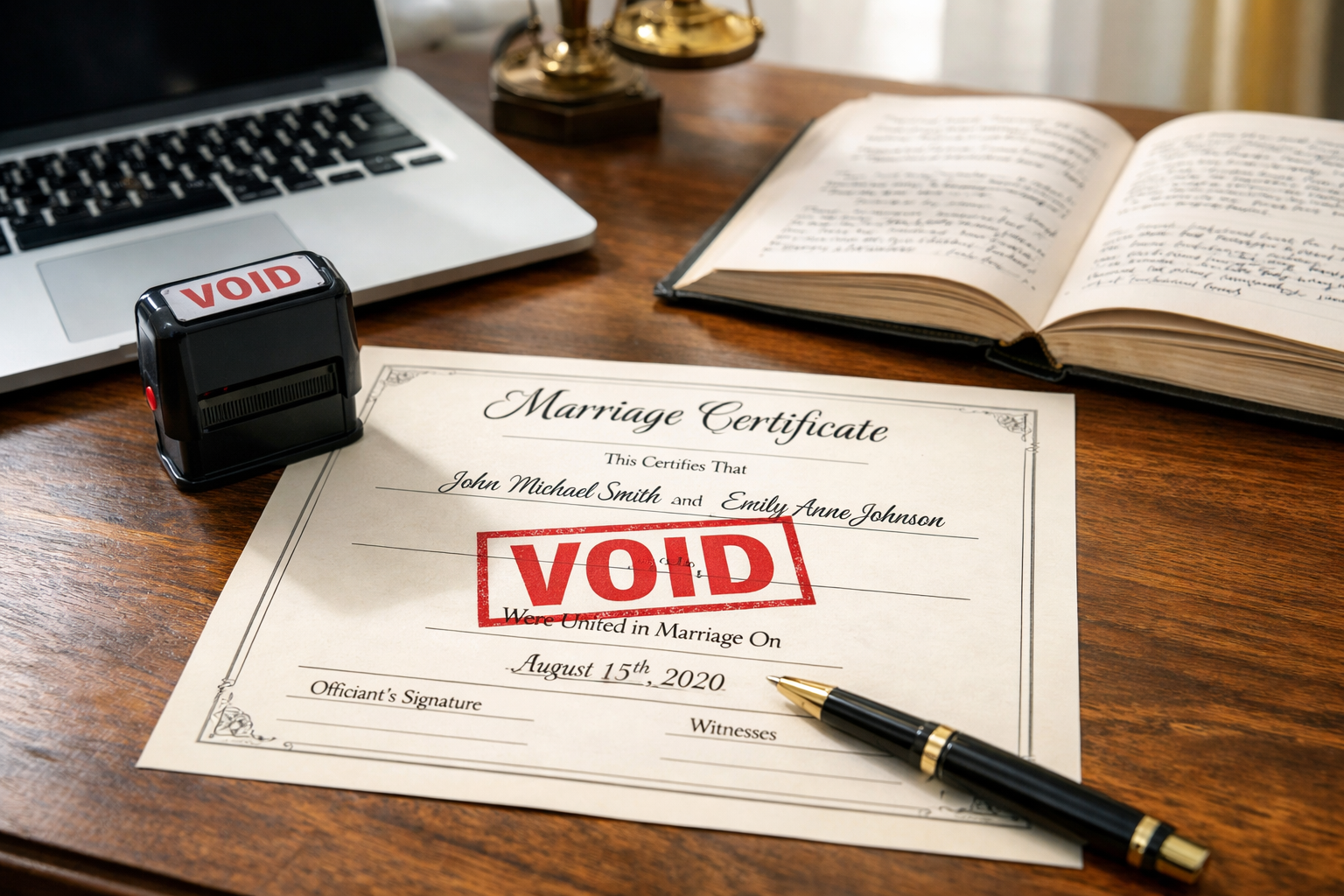
Void vs Voidable Marriages: The Critical Distinction
Not every defective marriage is treated the same in law. South African law distinguishes sharply between void and voidable marriages, and this distinction determines whether a marriage ever existed in law, or whether it exists until a court declares otherwise.
A void marriage is one that is invalid from the outset. It never comes into legal existence because it violates an essential legal requirement. No marital bond is created, even if the parties believed themselves to be married and conducted their lives accordingly.
A voidable marriage, by contrast, is legally valid unless and until it is set aside by a court through annulment proceedings. Until that happens, the marriage produces full legal consequences, including property and spousal rights.
This distinction is often misunderstood, with serious consequences — particularly where estates, pension benefits, or competing spouses are involved.
Void Marriages
A marriage will be void where it violates a fundamental rule of law. Typical examples include:
- A bigamous marriage, where one party purports to marry while already married under the Marriage Act
- A marriage between persons within prohibited degrees of relationship
- A marriage concluded without compliance with mandatory statutory formalities
- A marriage entered into without legal capacity or genuine consent
In such cases, the marriage is regarded as void ab initio — null and void from the beginning. No annulment is required to bring it to an end, although a declaratory order is often sought to confirm its invalidity and ensure legal certainty.
Voidable Marriages
A voidable marriage, on the other hand, exists in law until it is annulled by a court. Grounds for voidability typically include:
- Defective consent, arising from fraud, misrepresentation, or duress
- Mental incapacity at the time of marriage
- Certain underage marriages concluded without proper consent
- Physical incapacity, such as permanent impotence unknown to the other spouse at the time of marriage
Unless and until a court grants an annulment, the marriage remains legally effective, often with significant financial and estate consequences.
The Case of K v P: A Classic Void Marriage
The facts of K v P illustrate a clear example of a void marriage.
The Plaintiff entered into a customary marriage with the Defendant in 2006 after he represented that he was unmarried. The parties lived together as husband and wife, and the Plaintiff regarded the marriage as valid. However, when she attempted to register the marriage with the Department of Home Affairs, she discovered that the Defendant had been legally married since 1991 under the Marriage Act, and that this civil marriage had never been dissolved.
In terms of the Recognition of Customary Marriages Act, a person who is a spouse in a civil marriage is prohibited from entering into a customary marriage with another person while that civil marriage subsists. The Defendant’s deception rendered the customary marriage unlawful.
The court accordingly declared the marriage void ab initio, confirming that no valid marriage ever existed in law.
Bigamy, Deception, and Legal Consequences
K v P also highlights the intersection between marital validity and bigamy. In South African law, bigamy is a criminal offence. Any marriage concluded while a prior civil marriage subsists is automatically void and may expose the offending party to criminal liability.
Beyond the invalidity of the marriage itself, the Defendant’s conduct had serious civil consequences. The Plaintiff instituted a claim for general damages under the actio iniuriarum, alleging that the Defendant’s deception impaired her dignity, reputation, and emotional well-being.
A further aggravating factor was the Defendant’s discriminatory conduct toward the Plaintiff based on her HIV status, which the court found to be a violation of her constitutional rights to equality and human dignity. While the Plaintiff initially claimed R150 000 in damages, the court awarded R45 000, reflecting the seriousness of the infringement while remaining proportionate to the circumstances.
Legal Principles Confirmed by the Court
The judgment reaffirmed several important principles:
- A customary marriage entered into while a civil marriage subsists is void from inception
- Deception regarding marital status constitutes wrongful and actionable conduct
- The actio iniuriarum remains an appropriate remedy for infringements of dignity and reputation
- Constitutional rights apply fully within marital and intimate relationships
Practical Consequences of Invalid Marriages
The consequences of a void or voidable marriage often emerge only at moments of crisis, during divorce proceedings, succession disputes, or pension claims. In many cases, spouses discover the existence of a prior marriage only after a death, when competing claims arise against a deceased estate.
While children born of both void and voidable marriages remain legally protected under the Children’s Act, spouses may find themselves without the legal protection they assumed marriage provided.
Preventative Steps
Prospective spouses should consider conducting a marital status verification at the Department of Home Affairs, noting that both parties must attend in person. Couples should also seek legal advice on matrimonial property regimes, ensuring clarity on whether they marry in community of property, out of community with accrual, or without accrual.
A small amount of diligence before marriage can prevent years of litigation and emotional distress.
Conclusion
Understanding the distinction between valid, void, and voidable marriages is essential in South African law. While a valid marriage provides certainty and protection, a void marriage offers none, and a voidable marriage carries hidden risks until annulled. K v P stands as a cautionary example of how deception and bigamy can render a marriage legally meaningless, leaving an innocent spouse exposed.
Marriage may begin with love and intention, but it endures through legal compliance. Knowing the law before, and during, marriage is not pessimism; it is protection.
\ Get the latest news /

