Your Marriage Is Valid, But Can You Prove It?
 Moletelaw
Why registering your customary marriage before 31 August 2026 could save you years of legal and administrative difficulties.
Just a reminder, or notification if you did not know, on the 16th of July 2026, the Department of Home Affairs issued its final reminder that the August deadline of the 31st marks the close of the special registration period for customary marriages.
The Department had initially made the announcement on the 29th of October 2024, giving couples married in terms of customary law a two year window to register their marriage.
You may be wondering why this is a requirement if, in terms of the Recognition of Customary Marriages Act 120 of 1998, once all the requirements stated in section 3(1) of the Act are met, the marriage is already valid?
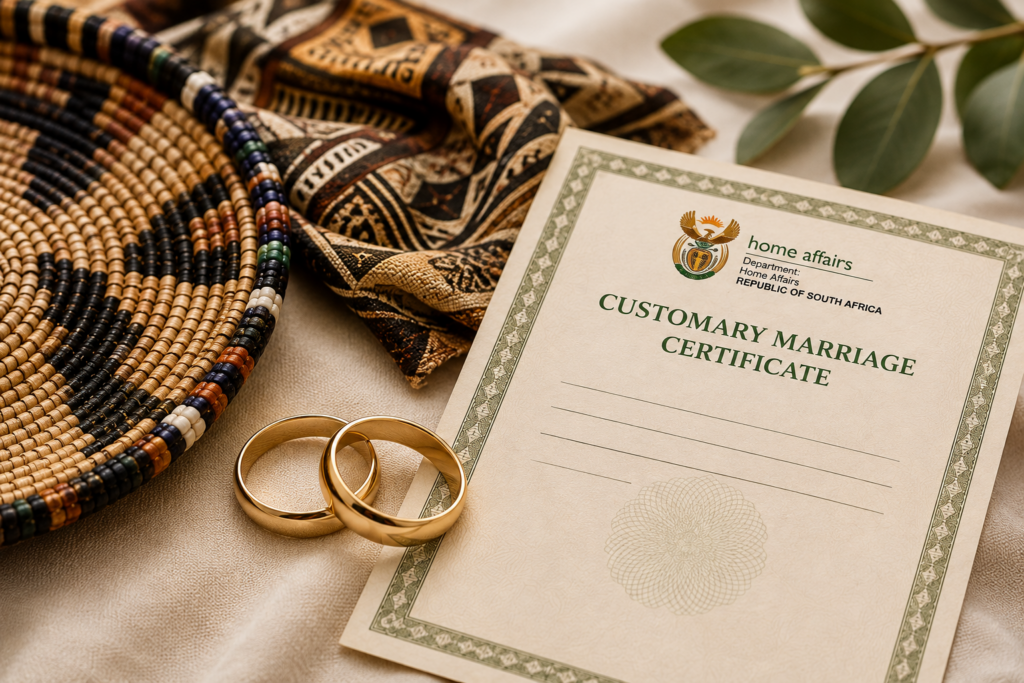
The Department of Home Affairs stipulates that registering a customary marriage is important because it provides official proof of the union, which is vital to protect spouses' legal rights regarding inheritance, property, and banking. While unregistered customary marriages remain legally valid if traditional requirements are met, lacking a certificate creates severe practical hurdles.
From a legal perspective, this position is well founded. Experience has shown that the absence of a marriage certificate can create significant legal and administrative difficulties, particularly in divorce proceedings and the administration of deceased estates. It may also give rise to disputes over the proprietary consequences of the marriage, including the division of a joint estate where the marriage is one in community of property, and can increase the risk of fraudulent or opportunistic claims regarding the existence or non-existence of the marriage. In numerous court cases, spouses and family members have first had to prove that a valid customary marriage existed before a divorce could be finalized or before inheritance and other rights flowing from the marriage could be recognized. As our courts have demonstrated in cases such as Dladla v Manana and Others (2023/125417) [2026] ZAGPPHC 1, disputes concerning the existence of a customary marriage can become lengthy, costly and emotionally draining.
A Home Affairs marriage certificate provides documentary evidence of your marital status, making it far easier to deal with estates, pension benefits, medical aid, property transactions, and many other legal processes.
Who Does This Announcement Apply To?
Registration of marriages is required from couples who concluded their marriage before the Recognition of Customary Marriages Act came into effect in November 2000, as well as marriages concluded thereafter that were not registered within the prescribed timeframe.
If your customary marriage was concluded before 15 November 2000 and has never been registered, you may qualify to register it during this special registration period. Similarly, if your customary marriage was concluded on or after 15 November 2000, but it was never registered within the prescribed period, this registration process may also apply to you.
It is important to remember that this process is intended for valid customary marriages. Registration is not a mechanism for creating a marriage that never existed. Before Home Affairs can register a customary marriage, it must be satisfied that the legal requirements for a valid customary marriage have been met.
- For marriages concluded before the commencement of the Act (November 2000): The marriage must have met the traditional customs and requirements of the specific indigenous African community at that time.
- For marriages concluded after the commencement of the Act: Both prospective spouses must be above the age of 18 years, both parties must consent to marry each other under customary law, neither party can already be married in a civil marriage to someone else, parties must not be closely related by blood within prohibited degrees of relationship, and the marriage must be negotiated and entered into or celebrated in accordance with customary law.
What Is Required to Register?
To register a customary marriage in South Africa, both spouses together with one family representative each must visit a Department of Home Affairs office to submit the necessary documentation and details. While the standard process expects registration within three months of the ceremony, this special window allows couples to regularize older or delayed unions by providing the following required documents and details:
- Identity Documents: Green ID books or smart ID cards of both spouses.
- Completed Form: Form BI-1699, issued by the Department of Home Affairs.
- Lobola Details: Information or proof confirming the lobola agreement.
- Family Witnesses: The Department explicitly requires the presence (or supporting statements) of at least one witness from the bride's family and one from the groom's family, or designated family representatives, who can verify that the customary marriage took place.
- Administrative Fee: Payment of the prescribed Home Affairs fee.
If Home Affairs is not satisfied with the evidence provided, refuses to register the marriage, or if one spouse refuses to cooperate with the registration process, the other spouse may approach a court for an order declaring the customary marriage valid and directing Home Affairs to register it.
While the courts remain available to resolve these disputes, litigation is often time consuming, costly and emotionally taxing. Registering your customary marriage while this special registration period remains open may help avoid these challenges altogether by providing official proof of your marital status from the outset.
With the 31 August 2026 deadline fast approaching, eligible couples who have not yet registered their customary marriages should take advantage of this special registration period. Registering your marriage now can provide certainty, safeguard your legal rights, and spare you and your family unnecessary legal disputes and administrative difficulties in the future.
\ Get the latest news /

